
Sceptics told me, “The idea already exists.” Others said, “No one will pay for it.”
I woke up tired and discouraged on the morning of my presentation at the Communicating for a Better World conference in New York.
I was about to share the findings of a survey of 175 social impact communications professionals and introduce my idea to create a global peer-to-peer communications community.
The survey results were encouraging, but I’d heard plenty of reasons why the idea wouldn’t work. I was having serious doubts. Was there really a need for another community? Was I wasting my time?
I decided to go ahead anyway.
The survey revealed some interesting findings about the communications challenges facing professionals working in the social impact sector, from shrinking resources and audience engagement to the growing need for peer learning and collaboration.
Here are the five main findings I presented, and what they tell us about how we could work better together.
What are the biggest social impact communications challenges?
Between August and October 2026, I surveyed 175 communications professionals working across the UN system, NGOs, foundations, government and the private sector.
The respondents were experienced professionals. 77% identified as senior communications managers, Heads of Communications or Communications Directors. Around 38% worked for UN or other multilateral organisations, while 35% worked for NGOs and associations.
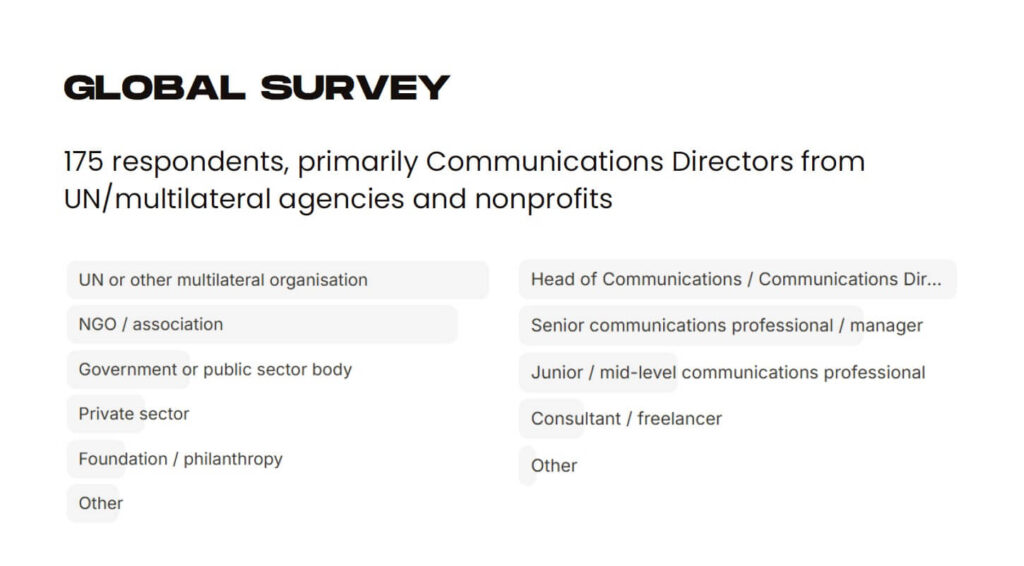
What did they say? The survey offers a useful snapshot of the challenges that experienced communications professionals face, and the support they’re looking for.
1. Limited resources are our biggest communications challenge
Almost half of respondents (48%) identified managing communications effectively with limited time, budgets or resources as their biggest challenge.
Another 26% pointed to the challenge of reaching and engaging the right audiences, while 11% identified keeping up with new skills and technologies as a major barrier.
These findings resonated with conversations I’d been having with UN communications professionals about restructuring and budget cuts. One person told me, “We’re no longer doing more with less, we’re doing less with less.” Another spoke of the devastating impact of staff reductions on their department.
Communications teams are being stretched thin, often expected to manage everything from strategy and media relations to social media, video production, websites and events.
Some of the survey’s written comments raised another concern: senior leadership doesn’t always understand or value strategic communications. One respondent identified their biggest challenge as “poor leadership that doesn’t understand or value strategic communications.”
These challenges go beyond finding the right tools. They affect how communications teams operate, set priorities and demonstrate their contribution to organisational goals. And as communications budgets decrease, finding more efficient ways to work becomes increasingly important.
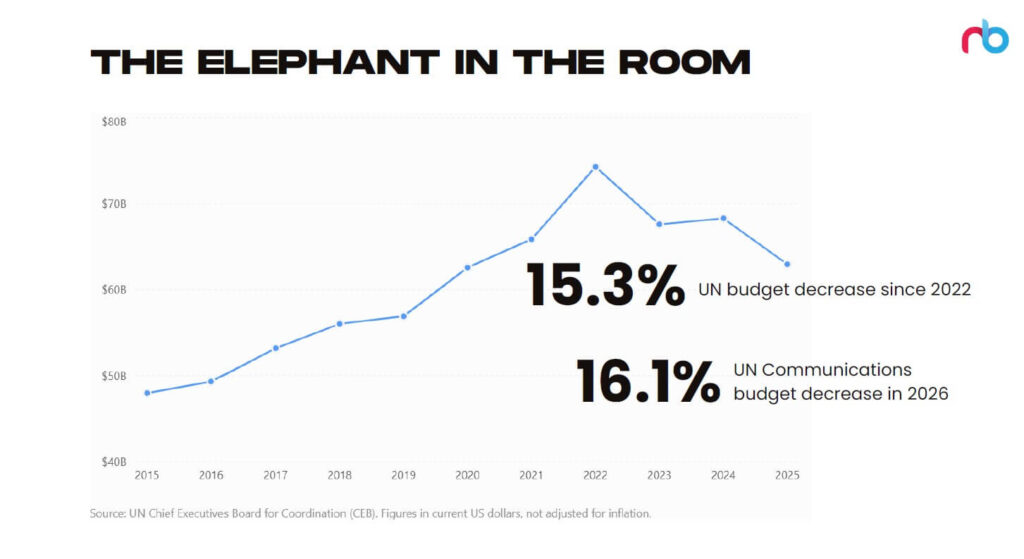
2. We’re seeking advice from peers, but many lack a professional network
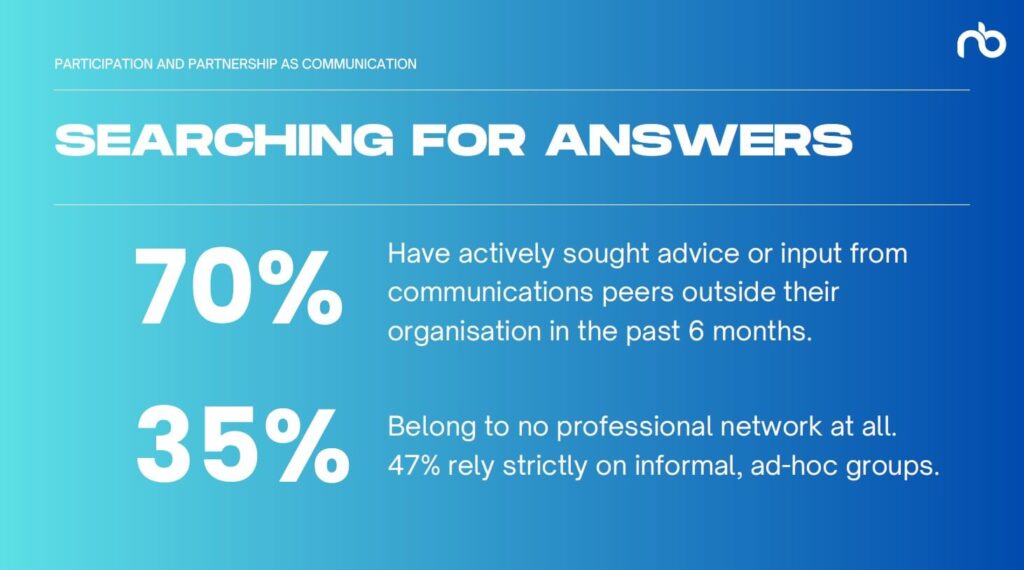
This was one of the most extreme findings: 70% of respondents had actively sought advice or input from communications peers outside their organisation in the previous six months.
Yet 35% don’t belong to any professional network, while another 47% participate only in free networks.
Clearly, many communicators already turn to colleagues for advice, ideas and solutions. But much of this exchange depends on informal relationships and personal contacts.
That raises an interesting question: Could a structured communications community make peer support easier to access, especially for professionals who don’t already have an extensive network?
Rather than relying on chance encounters or personal connections, communications professionals could have access to a trusted group of peers willing to exchange ideas, share experiences and help solve problems.
3. Peer learning is what communications professionals value most
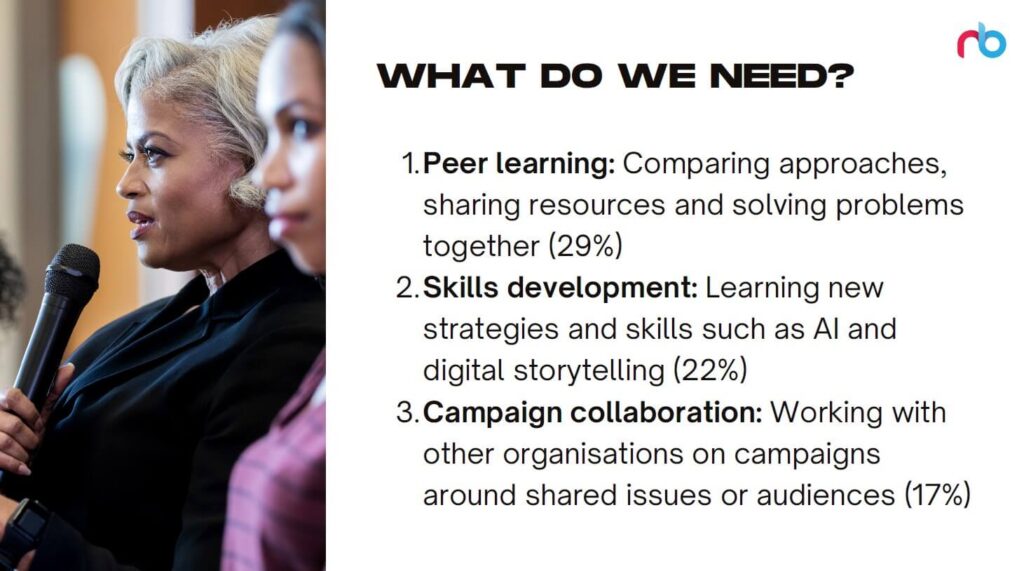
When asked what they would find most valuable in a professional community, respondents could select two options, and the results showed peer learning as the strongest preference:
- 54% — Peer learning: Comparing approaches, sharing resources and solving problems together.
- 41% — Skills development: Learning new strategies and skills, including AI and digital storytelling.
- 32% — Campaign collaboration: Working with other organisations on shared issues.
- 32% — Career development: Accessing professional opportunities and connections.
- 25% — Peer connection: Meeting people doing similar work.
For me, this suggests that a communications community needs to go beyond traditional networking events and webinars.
Imagine a small group of communications professionals discussing a real challenge: how to reach younger audiences, demonstrate campaign impact or tell more compelling stories.
Members could compare approaches, share examples of what has worked (and what hasn’t), and develop practical solutions they can apply in their own organisations.
The expertise already exists. The challenge is making it easier to find, exchange and use.
4. Cross-sector collaboration offers opportunities to learn from one another
I work with numerous different stakeholders so I can see a bigger opportunity. Communications professionals across the UN, NGOs, foundations, governments and the private sector often face similar challenges, yet they rarely collaborate.
An NGO might have developed an effective grassroots mobilisation campaign. A foundation might have found a better way to communicate the impact of its investments. A UN agency might have experience coordinating communications across multiple countries.
Why shouldn’t we learn from one another? Some of the best solutions to our communications challenges may already exist, but in another organisation or sector.
A cross-sector communications community could help us find those solutions, share knowledge and identify opportunities to collaborate rather than repeatedly developing similar approaches independently.
5. A professional community needs to deliver practical value
The survey also explored whether communications professionals would consider paying for a community that helped them save time and achieve their professional objectives.
Overall, more than 60% said they would consider paying, although most wanted to understand the cost before committing. Among those unwilling to pay, over 70% cited their organisation’s unwillingness to fund membership as the main obstacle. That’s huge! It’s a reflection of the huge pressures that communications professionals face in terms of budget and procurement.
But my main takeaway goes beyond affordability: a professional community needs to be worth people’s time. Members should be able to find practical advice, exchange useful resources, develop their skills and build relationships that help them overcome real challenges.
That means keeping the community focused on members’ needs, rather than simply offering another platform filled with content and discussions.
The opportunity: Building a community around peer learning
How can we learn from one another and collaborate more effectively across organisations instead of working in silos? This question became particularly relevant during the New York conference, where we discussed how communications could help strengthen the UN at a time of financial and institutional pressure.
With the UN80 reform initiative seeking to improve efficiency and reduce duplication, I believe there is a similar opportunity for communications professionals to make better use of their collective expertise.
A global peer-to-peer communications community could bring together professionals from across the social impact sector to discuss common challenges, share practical solutions and collaborate.
Watch the full 7-minute presentation from the “Communicating for a Better World” conference in NY.
What’s next?
Over the past few months, I’ve started bringing social impact communications professionals together through informal meetups in Lisbon and New York.
Now I’m exploring how to develop a global communications community where professionals can connect, learn and solve challenges together, regardless of where they work. My initial thinking includes small peer-learning groups, practical workshops, opportunities to exchange resources and a network where members can ask questions and get advice from experienced colleagues. That’s why I want to start by listening, testing ideas and building something that responds to what communications professionals actually need.
Which brings me back to that morning in New York.
After presenting the survey findings, I reached my final slide and invited the audience to scan a QR code to register their interest in the community. When I looked up, almost everyone in the room had raised their phone.
I breathed a huge sigh of relief — perhaps my idea wasn’t so silly after all!
Of course, registering interest doesn’t mean people will necessarily participate or become paying members. But seeing that response, after all my doubts, gave me hope that this was an idea worth pursuing.
If you participated in the survey, thank you. Your responses have helped me better understand the communications challenges facing our profession and the opportunities for working together.
If the idea of a global peer-to-peer community interests you, I invite you to join the community waitlist. You’ll receive updates as the social impact communications community takes shape and have opportunities to help shape its development.
Watch this space, as I co-create a community that can genuinely help us work better!
- Written by: Nicholas Bruneau
- Posted on: November 18, 2026
- Tags: communications trends
