
If you’re thinking of doing Strategic Communication Management Professional (SCMP®) exam, you’re probably asking the same question I did:
How do I prepare properly for the SCMP exam without underestimating it?
Backed by the International Association of Business Communicators (IABC), the SCMP is one of the most rigorous certifications in the communication profession.
Preparation for the SCMP is like a PhD in communications — it requires a full review of the communications function to demonstrate proficiency in strategic development, C-Suite leadership, innovation, ethics, and reputation management.
Many people say they are strategic, but few actually have a certificate to prove it.
That’s why the SCMP is ISO-certified by the Global Communication Certification Council, so you can be certain that it meets the highest standards of professionalism & competence in communication.
For those who earn it, the SCMP signals strategic credibility. And because of its rigour, structured and deliberate SCMP exam preparation is essential.
I spent approximately six months preparing methodically and deliberately.
Here is exactly how I approached my SCMP exam preparation and what made the difference.

1. What to Expect from the SCMP Exam
First and foremost, understanding the SCMP exam format is essential. Here’s what you need to know.
Timing
The SCMP exam is computer-based and typically allows 3.5 hours (210 minutes) to complete the test. Time management matters. While you are given sufficient time, the scenarios require careful reading and structured thinking. A useful strategy is to:
- Answer each question confidently
- Tag uncertain ones
- Return to flagged questions at the end
Number and Type of Questions
The exam includes approximately 100 multiple-choice questions. Each question presents:
- A realistic professional scenario
- Four answer options
- One best answer aligned with the Global Standard
SCMP exam questions are scenario-based, not definition-based, and sometimes all the answer choices sound plausible. So the exam evaluates judgment, sequencing, and strategic alignment. Essentially, you’re being tested on your ability to identify the most strategic and ethically aligned response.
Topics Covered in the SCMP Exam
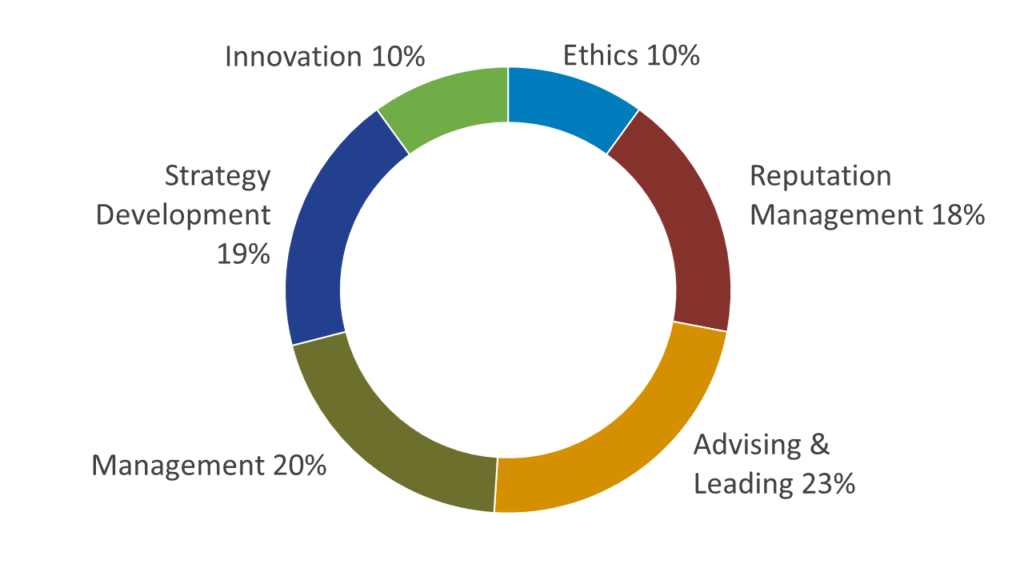
The exam is based on the Global Standard for the communication profession and evaluates senior-level capability across multiple domains, including:
- Advising and Leading
Strategic counsel, executive advisory, influence at enterprise level - Communication Management
Governance, planning, integration, and execution oversight - Strategy Development
Situation analysis, stakeholder alignment, objectives, risk management - Ethics and Professional Standards
Ethical decision-making, transparency, credibility, compliance - Reputation and Risk
Crisis leadership, issues management, trust and stakeholder impact - Innovation and Change
Organizational transformation, internal alignment, future readiness
You can find out more in the SCMP Study Resources section of the GCCC website.
2. The Application Process
To apply for the SCMP, you need to demonstrate 11 years of relevant experience, prove that you have attended a minimum of 20 hours of professional development in communication within the two years prior to applying, and submit a formal letter of recommendation from a senior leader for whom you have provided strategic communication counsel.
It’s not cheap either! At the time of writing this post, the application fee is:
- USD $100 for IABC members
- USD $400 for non-members
Once you’re registered, the exam fee is USD $400.
In total, the first attempt typically costs around $500 for IABC members and $800 for non-members, excluding optional study materials or professional development courses. Therefore, when doing the SCMP exam, it’s much more beneficial to be an IABC member.
There’s also a retake fee if needed, and a small annual maintenance fee to keep the certification active.
While the cost is significant, it reflects the rigour and credibility of the SCMP designation. For many senior communication professionals, it’s an investment in their long-term professional career.
Having “SCMP” after your name not only positions you as a strategic communications leader, but it also provides independent, internationally recognised validation of your strategic judgment and advisory credibility. If you are a consultant, it can even help you attract new clients and secure higher rates thanks to the prestige of the certification.
3. Go Back to Basics
To meet the 20-hour professional development requirement, I decided to take the Corporate Communication Specialization from UC Irvine via Coursera, which is approximately 25 hours of online training. You also get a certificate of completion that can be featured on LinkedIn, which is a nice bonus!
This way, I was not only getting all my required hours, but I was also catching up on some important topics like PR, crisis comms, digital strategy and internal communications.
To complete the course in one month, I set a simple rule: wake up 1 hour earlier every day and study for 25 consecutive mornings.
If you’re preparing, I recommend blocking protected time. Morning study works well because you avoid decision fatigue and interruptions. This created momentum and helped motivate me for the work ahead.
If you’re preparing, block protected time. Morning study works well because you avoid decision fatigue and interruptions.
4. Memorize the Global Standard
Even though I’ve been working as a strategic communications consultant for over 10 years, I felt that it was necessary to review the latest industry strategies and frameworks. For this reason, I purchased The IABC Guide for Practical Business Communication and read it cover to cover.
I used a three-layer approach:
- Highlighting key frameworks
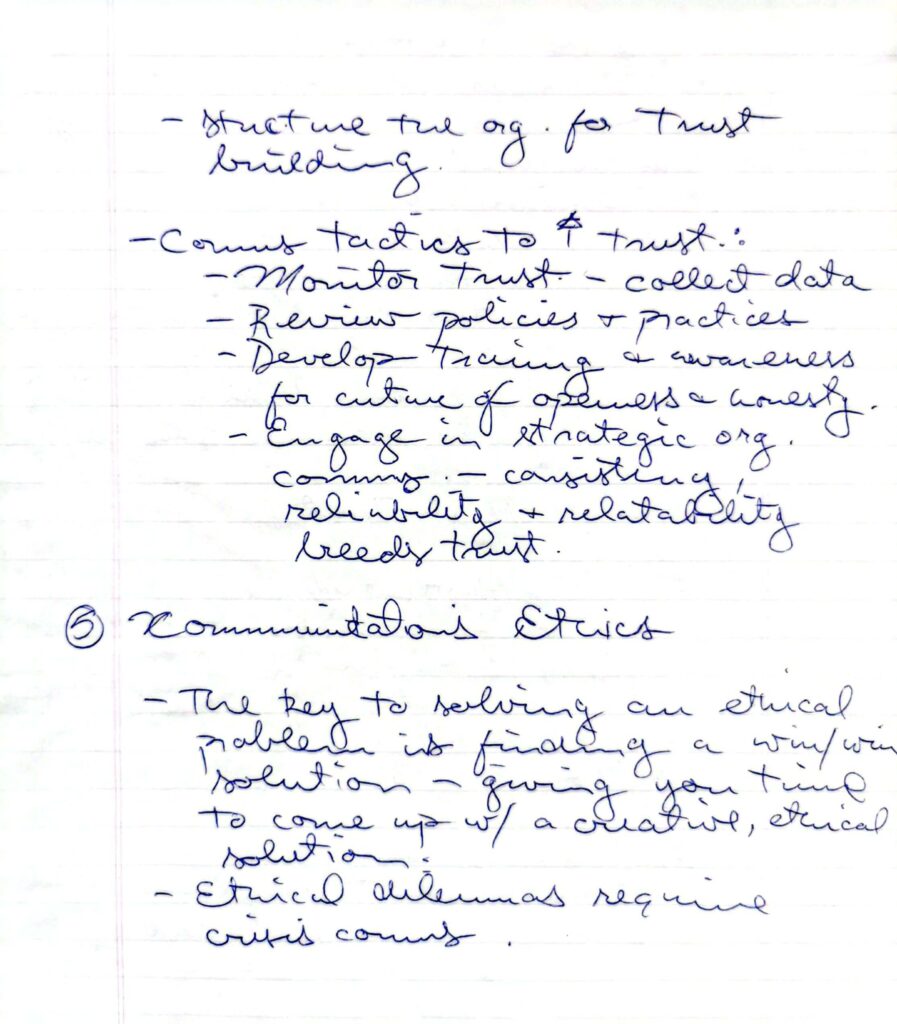
- Rewriting key insights by hand
- Consolidating all frameworks into one master summary document
The objective was not only memorization, but also pattern recognition.
The SCMP exam requires you to quickly distinguish strategies and foundational principles during the exam. You’re faced with various situations and need to swiftly determine which approach to take in line with best practice.
Creating my own consolidated framework document helped me internalize these structures.
Then the next step was to find recent examples and bring my notes to life: for this I took a chance and announced on social media that I was preparing for the SCMP and would publish a post every day for 30 days with examples from all categories in the exam: Ethics, Strategy Development, Advising & Leading, Management, Innovation and Reputation Management.
This exercise helped to match theory with practice by obliging me to find cases studies for each of the key areas tested in the exam.
5. Practice Makes Perfect!
Once I felt like I had the theory down pat, I purchased the official study guide, “Mastering Strategic Communication: A GCCC Study Guide”. It’s available for US$50 from the Centre for Strategic Communication Excellence (CSCE) website. The guide is helpful for understanding exam domains, seeing how questions are structured and recognizing common traps.
However, even after completing the guide I still didn’t feel confident and wanted to do more tests, but couldn’t find any that were readily available.
Therefore, using my notes from the IABC Guide for Practical Business Communication and the study resources from the GCCC website, I created a project in ChatGPT.
I used ChatGPT’s “Study Mode” to generate SCMP-style multiple-choice questions and leverage AI to help me prepare. This allowed me to:
- Practice by domain
- Focus on weak areas
- Request explanations
- Increase difficulty
- Simulate scenario-based reasoning in my spare time
To add variation, I also used Google’s NotebookLM with the same materials to generate additional questions using “Quiz Mode“. I asked the LLMs to increase the difficulty and added the apps on my phone so that I could do a few questions during breaks, practice on weekends and in my spare time. Using NotebookLM, I even created video overviews like the one below.
This kept my training consistent but manageable, while increasing my confidence little by little.
6. Being Ready for Exam Day
If you’re doing your exam remotely, you’ll need to download a specific browser and make sure that your computer has the required memory and capacity. Find out more here.
At the beginning of the exam, I was concerned about timing. There are many questions and a fixed time limit. I initially rushed a few, but then the preparation kicked in. I began recognizing patters and frameworks, and once I found that rhythm, answering became faster. The questions were much harder than I thought, but in the end, I finished with time left over.
As mentioned earlier, the exam allows you to tag questions and return to them later. I strongly recommend this, as it allows you to keep momentum and decrease the stress of answering everything right away.
Before exam day:
- Download the Guardian Browser
- Ensure system compliance
- Run technical checks
- Clean your desk to reduce clutter and operational risk.
7. The Best Piece of Advice I Received
One of the best pieces of advice I received was from Sia Papageorgiou FRSA, FCSCE, SCMP, the Co-Founder of the Centre for Strategic Communication Excellence. In an IABC webinar she said:
“The SCMP exam tests best practice in ideal conditions.”
In real life, communication leaders often face budget pressure, politics, and time constraints. In the SCMP exam, the correct answer reflects what should happen under professional standards, not what might happen in reality.
Understanding this distinction was critical for success.
The SCMP exam tests best practice in ideal conditions.
Sia Papageorgiou, FRSA, FCSCE, SCMP, Centre for Strategic Communication Excellence
Overall, if I can summarize the top three strategies that worked:
- I reviewed the basics and best practices, taking my time to refresh my knowledge and theoretical background
- I followed a structured study discipline: setting a plan with daily sprints, one hour a day
- I tested my ability using the GCCC Study Guide, and leveraged AI to create more tests using “study mode”.
All in all, it’s a mindset shift: the SCMP certification tests how strategically you think according to best practice. It’s a challenge, but if you truly want to engage with impact, it is really worth it and will certainly elevate your knowledge and career.
I hope this post has helped and wish you the best of luck!
